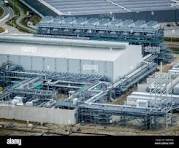
Energy control. SB Energy owns the power generation — gas-fired, secured at scale — rather than purchasing power from utilities at market rates. In a market where data center operators are scrambling for contracts, that upstream control is a genuine cost advantage that compounds at 10GW scale.
BlackRock:
Investors Are Betting Big on Data Centre Energy - US$1.5tn was invested in AI during 2025, much of it concentrated among a small group of firms.
Infrinia GPU Cloud OS and gas-fired power give SB Neo a structural edge over pure-play GPU landlords.
On July 2, 2026 — one day after a Bloomberg report sent CoreWeave down nearly 14% and Nebius Group down 17% in a single session — SoftBank Corp. and SoftBank Group Corp. announced SB Neo, Inc., a new U.S. neocloud subsidiary that will begin renting GPU compute to American enterprises and hyperscalers. The timing was deliberate. By stepping into the AI cloud race at the precise moment that market confidence in the pure-play GPU rental model is wobbling, SoftBank is signaling that it sees a structural opportunity — not in renting NVIDIA racks like everyone else, but in owning the energy supply, the software stack, and a strategic stake in the dominant AI lab.
SB Neo will be incorporated in Delaware in July 2026, owned 51% by SoftBank Corp. and 49% by SoftBank Group Corp., and consolidated onto SoftBank Corp.'s balance sheet. Commercial neocloud services are scheduled to launch in fiscal year 2027, the period ending March 31, 2028. The target: 10 gigawatts of deployed AI data center capacity by around 2030 — a figure that would place SB Neo among the largest cloud infrastructure operators on the planet.
For context, one gigawatt of continuous data center power can support the equivalent load of roughly 750,000 homes simultaneously. Ten gigawatts is a commitment of a different order: roughly the entire power capacity of a mid-size state's grid on a peak summer day.
SoftBank Corp. CEO Junichi Miyakawa framed the timing around power visibility, not GPU pricing. The launch decision followed what he described as "steady progress toward securing 10 gigawatts of power" in the United States — a statement that signals SoftBank's edge is upstream of the GPU rack, in the infrastructure layer that makes the GPU rack possible at all.
The technical foundation SB Neo will bring to the U.S. market is Infrinia AI Cloud OS, a proprietary software stack that SoftBank's Infrinia team began deploying in Japan in beta form in May 2026 on NVIDIA GB200 NVL72 hardware.
Infrinia operates across the full GPU infrastructure stack — from BIOS and RAID configuration through operating system, GPU drivers, networking, Kubernetes controllers, and storage — automating tasks that require specialized engineering teams to perform manually in competing deployments. The result is two services delivered on top of the automated hardware layer: Kubernetes-as-a-Service (KaaS) for multi-tenant GPU environments, and Inference-as-a-Service (Inf-aaS) that exposes large language model inference through OpenAI-compatible APIs, allowing existing AI applications to connect without modification.
The hardware Infrinia runs on is engineered for exactly this purpose. The NVIDIA GB200 NVL72 rack integrates 72 Blackwell GPUs across 18 hosts, connected by NVLink — a high-speed interconnect that allows all-to-all GPU communication at 1.8 terabytes per second within the rack. That architecture effectively turns each rack into a single addressable memory pool rather than 72 independent GPU nodes, which matters for the largest LLM training and inference jobs, where inter-GPU communication latency is often the performance bottleneck.
The engineering tradeoff Infrinia makes is deliberate: by automating everything from BIOS upward and standardizing on NVIDIA GB200 NVL72, SoftBank reduces total cost of ownership compared with bespoke builds, but binds SB Neo's infrastructure to NVIDIA's hardware roadmap. For customers, the benefit is an OpenAI-compatible inference API that works on day one, without Kubernetes expertise; the constraint is that the software stack is not designed to be hardware-agnostic.
The anchor site is the Portsmouth AI Technology Campus in Pike County, Ohio, where SB Energy — SoftBank's energy subsidiary — is building a data center campus on leased U.S. Department of Energy land at the former Portsmouth Gaseous Diffusion Plant, a Cold War-era uranium enrichment facility. The project, announced March 20, 2026, alongside U.S. Energy Secretary Chris Wright and Commerce Secretary Howard Lutnick, envisions as much as $500 billion in total investment across data center halls, AI semiconductors, and associated power infrastructure at full 10GW build-out. The first 800-megawatt phase will be backed by $10 billion from SB Energy and is expected to come online around 2028. SB Energy is simultaneously building $4.2 billion in new electrical transmission infrastructure in southern Ohio with American Electric Power to ensure the project pays for its own grid impact rather than passing costs to residential ratepayers.
The second project is a 1.2GW data center in Milam County, Texas, built in partnership with OpenAI as part of the Stargate joint venture.
The power strategy for both sites relies primarily on gas-fired generation. SB Energy has committed to 9.2GW of new natural gas generation capacity as part of the Ohio project. Miyakawa made the energy sourcing explicit: SoftBank's competitive edge comes from "the ability to secure sources of power, mainly from gas-fired plants" — a statement that identifies gigawatt-scale power control as the differentiator, not GPU procurement alone.